
Home / News /
The $296,000 Acre: How AI Is Triggering a Total Revaluation of American Land

The numbers are no longer subtle. According to Cushman & Wakefield’s latest Data Center Development Report, the weighted average price for U.S. data center land hit $296,000 per acre in 2025. More telling than the absolute number is the velocity: large parcels exceeding 50 acres surged by 23% in 2024 and accelerated to a 36% jump in 2025.
The message is clear: the moment a plot of earth enters a data center developer’s pipeline, it severs its ties to traditional agricultural or commercial pricing models. It is no longer "dirt"; it is a critical node in the global digital nervous system.
From Server Rooms to AI Factories
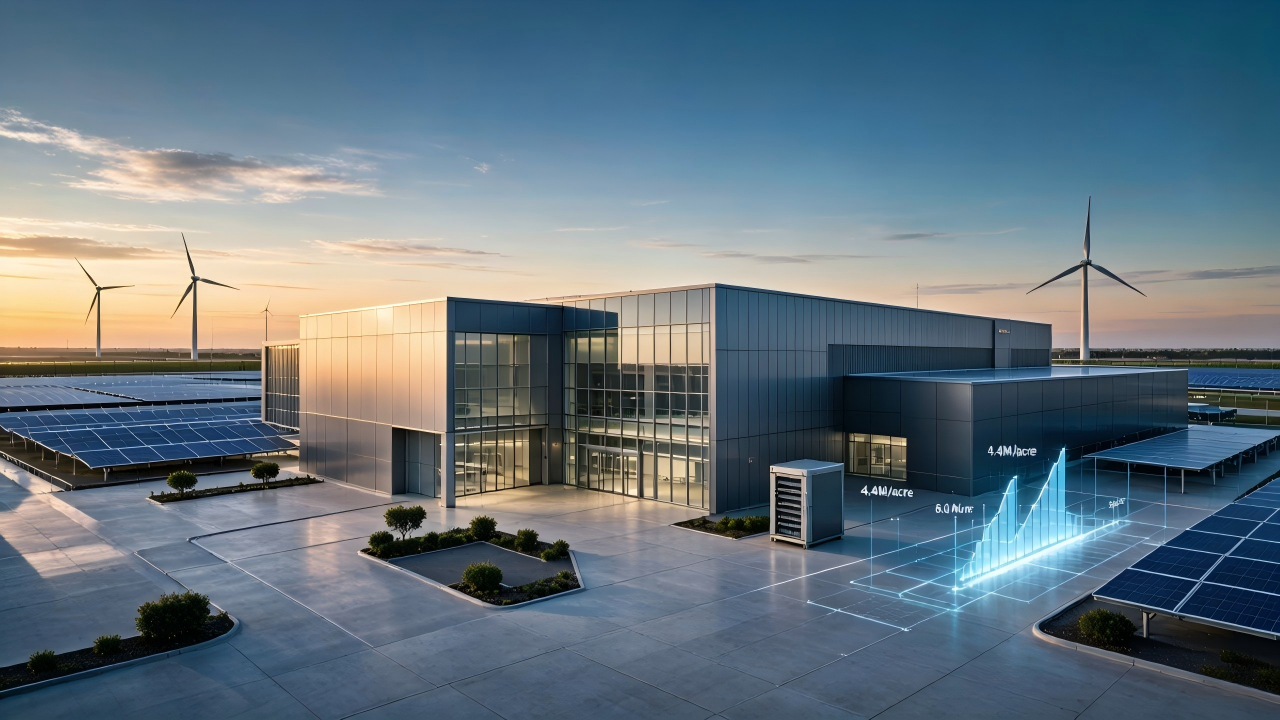
To grasp why this is happening, we must abandon the outdated image of a data center as a mere warehouse for servers. In the age of large language models and generative AI, these facilities have transformed into AI Factories.
The scale is staggering:
Legacy Centers: 20–50 acres.
Hyperscale Campuses: 50–200 acres.
AI Super Campuses: 500–1,000+ acres.
Mega-Projects: Consider the proposed 6,000-acre, 11-gigawatt AI-energy complex in the Texas Panhandle.
These are not real estate plays; they are national-scale digital infrastructure projects. And they consume land like an industrial revolution.
Northern Virginia: The Blueprint for Revaluation
If you want to see the future of land value, look at Loudoun County, Northern Virginia. Known as "Data Center Alley," this region is the world’s internet crossroads. Here, land pricing has completely detached from local market logic.
Residential-grade plots are being acquired by data center developers for $4.4 million per acre. Prime, ready-to-build hyperscale sites have cleared $6 million per acre. Compared to valuations just a decade ago, some parcels have appreciated by thousands of percent. This isn't appreciation; it is a fundamental reclassification of the asset.
The Real Bottleneck: It’s Not Land, It’s Power

One of the greatest misconceptions about the U.S. is that we have a land shortage. We do not. The United States has vast stretches of empty space. What it lacks are "Power-Ready" sites.
The single greatest constraint on AI growth is electricity. Projects aren't waiting for capital; they are waiting for megawatts. Consequently, land value is now dictated by proximity to infrastructure:
Substations and Transmission Lines
Natural Gas Pipelines
Long-Haul Fiber Optic Trunks
Rail Corridors and Interstates
Increasingly, developers are bypassing the grid with behind-the-meter power solutions, including gas-fired generation, microgrids, and massive battery storage systems. The land that hosts these utilities is the new gold standard.
Silicon Valley’s Brain, Texas’s Body
This shift is redrawing the map of American technology. For decades, Silicon Valley was the undisputed center of gravity, focused on the "Brain": AI models, software, chips, and venture capital.
But AI is a physical business. It requires immense amounts of energy, cooling, and space. This is creating a new geographic division of labor:
Silicon Valley: Remains the brain.
Texas: Provides the body.
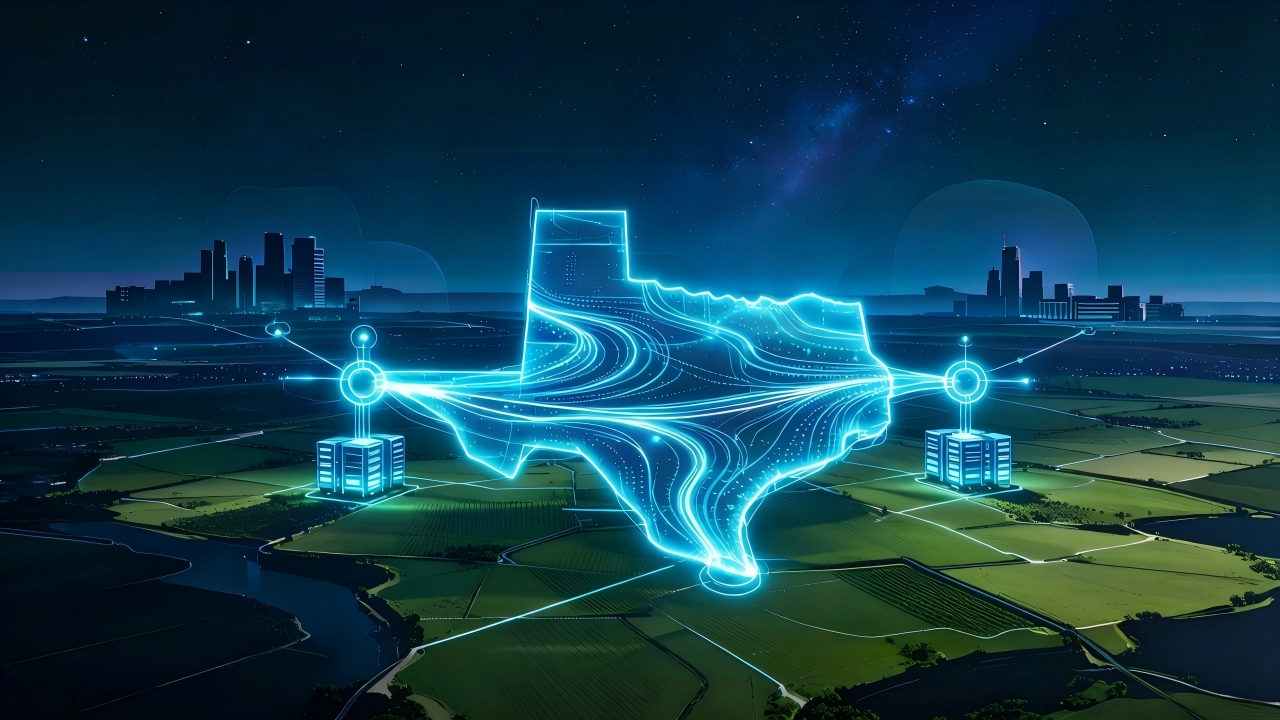
Texas offers the perfect trifecta: Power + Fiber + Land. With abundant energy resources, a deregulated grid (ERCOT) capable of rapid expansion, and vast tracts of affordable land, Texas is absorbing the physical footprint of the AI boom.

The Texas Triangle: The New Silicon Valley
Within Texas, a new megaregion is cementing its status as the premier AI infrastructure hub: the Texas Triangle.
The corridor connecting Dallas–Fort Worth (DFW), Austin, San Antonio, and Houston is now the fastest-growing tech ecosystem in the country. Austin ("Silicon Hills") houses the R&D and corporate presence (Tesla, Oracle, Apple, Samsung, Meta). Meanwhile, DFW is emerging as the nation's leading data center hub. CBRE now ranks DFW as a 1-gigawatt market, with 700 MW under construction and a staggering 3 GW in long-term planning.
I-35: America’s New Tech Spine
Historically, U.S. tech growth followed the path of California’s US-101. The future follows Interstate 35. This vertical spine connects the Texas Triangle and is becoming densely populated with AI compute clusters, chip fabs, and energy storage sites. The highest-value assets of the next decade will not be downtown skyscrapers, but the land parcels sitting along this infrastructure artery.
The Window Is Closing
The smartest capital is not waiting for the ribbon-cutting ceremony. By the time a project is officially announced, the ground-floor opportunity is gone. The real alpha lies in identifying Pre-Industrial Land—large, strategically located tracts near power and fiber that have not yet been rezoned or priced for their AI destiny.
Areas like DFW East (Forney, Sunnyvale, Kaufman County) exemplify this trend. They offer low-latency connectivity to major hubs, massive contiguous land parcels, and direct access to the utility corridors required for hyperscale development.

Conclusion
$296,000 per acre is not a price for growing crops. $6 million per acre is not a price for a shopping mall. These figures represent a paradigm shift: land is evolving from a passive commodity into an active, strategic infrastructure asset.
Silicon Valley may continue to invent the future. But Texas—and specifically the Texas Triangle—is building the factory floor where that future will run. As AI adoption accelerates, the great American land revaluation has only just begun.
![[background image] image of office setting](https://cdn.prod.website-files.com/691e77b067d72e1ba332c448/691e77eeda09a981ec5ad1d3_f190b5af-5394-4f7e-b008-b1162ed1ab67.avif)