

Home / News /
Those Who Mocked Wooden Houses Lost Their Jobs. What About Those Mocking Modular Homes Today?

When house hunting in the U.S. today, there is a fact that is easily overlooked yet subversive to conventional wisdom:
Whether it is a 500,000 entry-level home, a 5 million luxury estate, or a $10 million mansion, the structural core within those walls is most likely wood.
Industry data confirms this reality:
In 2024, 94% of new single-family homes in the U.S. were built using wood framing. (Eye On Housing)
Wood structure has long evolved from a "cheap substitute" into the industry standard for American housing.
But few know this: today’s mainstream was yesterday’s laughingstock.

The 1830s: Balloon Framing Disrupts the System
In the 1830s, a new construction technique emerged: Balloon Framing.
Before this, building a house relied entirely on master carpenters—hand-cutting timber, slow timelines, expensive labor, and zero scalability.
Balloon Framing completely rewrote the rules:
Standardized lumber plus industrial nails meant that even ordinary workers could be trained to build quickly. Efficiency, cost, and scale crushed the traditional craft.
Master carpenters of the time universally rejected it:
“Too light, unstable, not sturdy.”
“Cheaply pieced together; not a real house.”
Even the name Balloon was originally an industry insult, implying it was “light as air and flimsy.”
But markets don’t obey experience; they obey efficiency.
The final outcome was brutal:
Balloon Framing prevailed and evolved. The ones eliminated were the traditional master craftsmen who clung to their hand tools.
Post-WWII: Platform Framing Becomes the Standard
After WWII, America faced a national housing boom. Suburbanization exploded, Levittown scaled up, and millions of homes were delivered rapidly.
Platform Framing (modern wood framing) fully replaced the old ways and became the undisputed king of the industry.
Since then, the U.S. entered an 80-year era of wood-frame dominance. By 2024, 94% of new single-family homes still rely on this system.
What was once despised became the unified standard of the entire industry.

History doesn’t repeat, but it often rhymes.
Today, public opinion and industry skepticism are aimed squarely at one category:
Modular Homes / Factory Built Housing.
Traditional builders echo the same sentiments:
“Not a real house, lacks class.”
“Niche market, only good for affordable housing.”
“The market won’t accept it; it’ll never take off.”
The exact same bias. The exact same arrogance.
• 1830: Traditional artisans looked down on wood structures.
• 1950: Masonry systems looked down on wood-frame houses.
• 2026: Traditional site-built construction looks down on modular.
A review of industrial history shows: every fundamental innovation begins with doubt and ends with monopoly.

Every technological explosion is rooted in structural market contradictions.
The Harvard 2025 State of the Nation’s Housing Report concludes:
U.S. housing affordability is at its worst level in decades.
High prices combined with high interest rates have pushed new home sales to a 30-year low. (Joint Center for Housing Studies)
Meanwhile, the national housing shortage stands at millions of units. (Enterprise Community Partners)
Construction costs are rising across the board:
Land, labor, materials, insurance, and taxes climb year after year.
The current dilemma is straightforward:
It is not that young people do not want to buy homes; it is that the cost of traditional stick-built housing has exceeded what the average household can bear.
The industry urgently needs a more efficient, lower-cost, and controllable building system to break this deadlock.

The rise of Modular Homes is not a marketing gimmick; it is an efficiency upgrade at the industrial level.
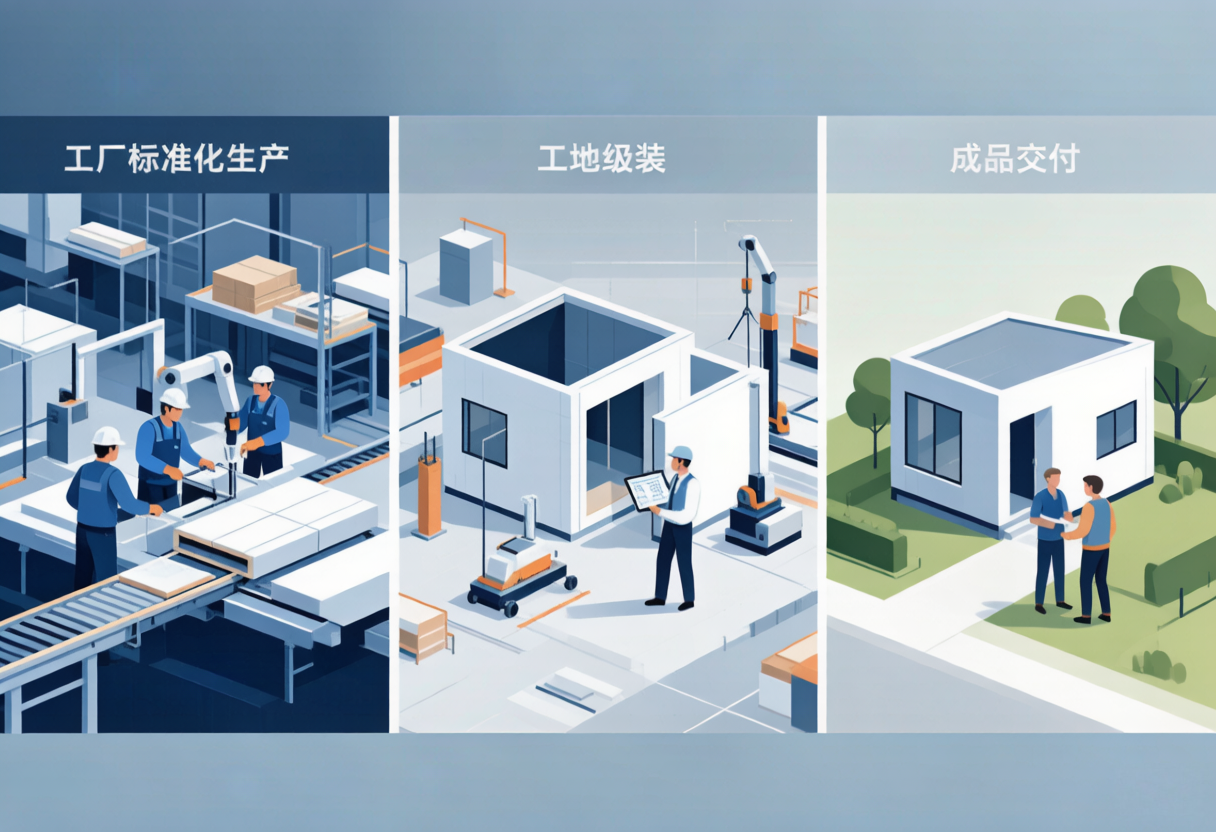
• Traditional Construction: Open-air sites, weather delays, uncontrollable labor, high waste, long cycles.
• Prefabricated Construction: Factory-standardized production, assembly lines, predictable schedules, stable quality, cost efficiency.
Core advantages run through the entire chain:
Massively compressed timelines, lower labor costs, reduced material waste, stable quality control, and high delivery certainty.
Data from Harvard’s Housing Research Center confirms:
Compared to traditional site-building, Manufactured and Factory-Built Housing possess significant, irreplaceable cost advantages. (Joint Center for Housing Studies)
The industry wind is shifting:
Policies nationwide are easing restrictions on Factory-Built Housing.
Authoritative institutions are conducting deep research.
Mainstream developers are entering the sector in bulk. (Habitat for Humanity)
Residential industrialization is no longer a question of "if," but a certainty.
Most people just see "prefab houses."
Elon Musk sees the industrialization of the housing sector.
Cars evolved from hand-assembly to assembly lines.
Rockets evolved from custom builds to industrial iteration.
The ultimate form of any mature industry is standardization, industrialization, and scale.
Real estate alone remained stuck for millennia:
On-site manual labor, one house at a time, non-standardized production.
Modular Homes are filling that last gap:
Future homes will be like cars and electronics—factory-built, standardized, and efficiently deployed.
This isn't a choice; it's the inevitable iteration of the industry.

The real question isn't:
"Will Modular Homes replace traditional housing?"
It is:
In the next 20 years, how much market share will they capture?
10%? 20%? 30%?
Or will they follow the trajectory of wood framing—from niche skepticism to the new industry standard?
The market follows one iron law:
It does not reward those who cling to tradition; it rewards those who embrace efficiency.
In 1830, the mocked wooden house ruled the American market for a century.
In 2026, the questioned Modular Home stands on the eve of its explosion.
Looking back decades from now,
those who stubbornly denied prefabricated housing today
will look just like the unemployed traditional carpenters of yesteryear—
underestimating the speed of the times.
Future generations might marvel:
"So, houses used to be built by hand, one by one, on a muddy construction site."
The era doesn't eliminate people;
it eliminates those who refuse to see trends and reject change.
![[background image] image of office setting](https://cdn.prod.website-files.com/691e77b067d72e1ba332c448/691e77eeda09a981ec5ad1d3_f190b5af-5394-4f7e-b008-b1162ed1ab67.avif)